 ETOS Global

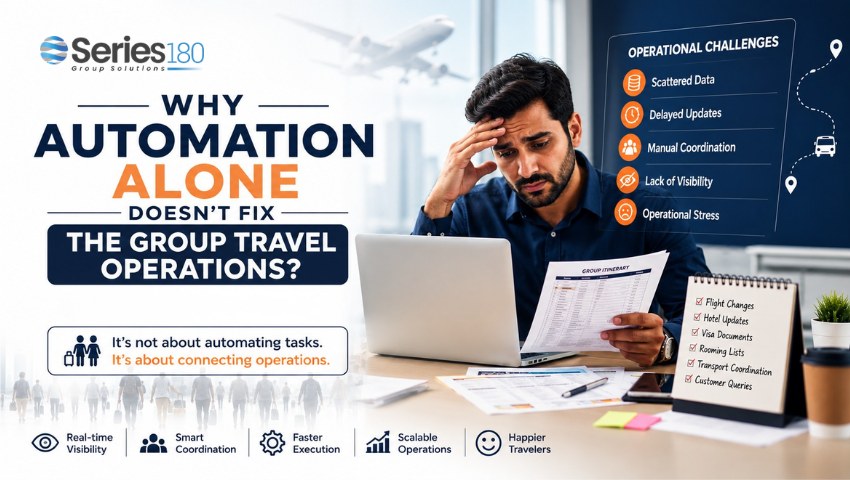
Each year, group travel operations are becoming more complicated. Travel companies are now managing multiple vendors, last-minute itinerary changes, coordinating pilgrims, payments, rooming lists, transport schedules and communicating with customers, all at the same time. Many travel businesses invest in automation tools expecting smoother operations, but they still face delays, miscommunication and operational chaos during peak seasons.
The reason is simple: automation alone can’t solve the problems of dynamic group travel execution. Today’s travel companies need connected operations systems that unify workflows, teams and real-time decisions.
The Real Problem Is Not Manual Work - It’s Operational Gaps
Most travel companies already use some level of automation:
- Excel automation
- WhatsApp communication
- CRM workflows
- Payment reminders
- Booking management tools
But group travel operations are not static workflows.
A single itinerary change can affect:
- Hotel Allocations
- Transport Coordination
- Visa Documentation
- Room Sharing
- Airport Pickups
- Guide Scheduling
Traditional process automation works well for repetitive tasks. But group travel operations require real-time coordination and execution systems that adapt instantly.
That is where many travel businesses struggle.
Why Traditional Automation Fails in Group Travel?
Automation tools are usually built for isolated tasks. They automate one process but fail to connect the entire operational journey.
For example:
- Booking teams work separately from operations teams
- Vendors receive updates late
- Pilgrim data stays scattered across systems
- Staff depend heavily on calls and spreadsheets
- Teams lose visibility during departures
As group sizes grow, these operational inefficiencies increase quickly.
The Result:
- Delayed responses
- Customer complaints
- Missed updates
- Staff overload
- Poor traveler experience
This is why many growing travel companies still face operational stress even after investing in automation software.
Modern Group Travel Needs Intelligent Workflow Coordination
Today’s travel businesses need more than task automation.
They need:
- centralized execution systems
- real-time operational visibility
- connected workflows
- automated coordination
- scalable group management
Modern travel operations depend on how quickly teams can respond to changes across departments.
Instead of managing operations manually between multiple tools, businesses now need platforms that unify:
- bookings
- operations
- pilgrim management
- accounting
- communication
- vendor coordination
This creates faster execution and better operational control.
How Series180 Helps Travel Businesses Scale Operations?
Series180 is designed specifically for travel businesses managing complex group operations.
Instead of offering standalone automation, Series180 helps companies streamline complete operational workflows from booking to departure.
With Series180, travel businesses can:
- Manage Group Departures Centrally
- Reduce Manual Coordination
- Improve Operational Visibility
- Track Real-Time Updates
- Simplify Traveler Management
- Coordinate Teams Faster
- Scale Without Operational Confusion
The platform is especially useful for:
- Umrah Travel Agencies
- Dmcs
- Group Tour Operators
- Corporate Travel Planners
- Religious Travel Businesses
By connecting departments and workflows, Series180 helps travel companies move from reactive operations to intelligent execution systems.
The Future of Group Travel Operations
The travel industry is shifting from simple automation to operational orchestration.
Businesses that continue depending only on disconnected automation tools may struggle with:
- scaling operations
- maintaining service quality
- handling peak travel demand
- improving customer satisfaction
The future belongs to travel companies that can combine:
- automation
- workflow coordination
- operational intelligence
- real-time execution
Because in group travel, execution speed matters more than isolated automation.
Book a Meeting with Series180 and simplify your group travel operations before operational gaps impact your growth.
Frequently Asked Questions (FAQs)
1. Why is automation not enough for group travel operations?
Ans: Automation handles repetitive tasks, but group travel requires real-time coordination between teams, vendors, bookings, and travelers.
2. What causes operational delays in travel businesses?
Ans: Disconnected systems, manual communication, spreadsheet dependency, and poor workflow visibility often create delays.
3. How can travel companies improve group departure management?
Ans: Using centralized travel operations platforms helps businesses manage bookings, communication, coordination, and traveler data in one place.
4. What type of travel businesses benefit from operational workflow platforms?
Ans: Umrah agencies, DMCs, tour operators, and corporate travel companies handling group movements benefit the most.
5. What is the difference between automation and operational coordination?
Ans: Automation completes tasks automatically, while operational coordination connects teams, workflows, and decisions across the entire travel process.






Leave a comment